
02 · Foundations
The 4 primary seasons.
Personal colour analysis begins with one idea: your natural colouring belongs to a season. Learn the warm and cool skintone groups, the primaries and secondaries that define a season, and the palette and physical traits of each.
10 min read · Hueme Academy

What are warm and cool skintones?
Every skintone sits somewhere on a single axis: warm or cool. It isn't about how light or dark your skin is — a porcelain face and a deep brown face can share the same temperature. What matters is the undertone: the quiet pigment that sits below the surface and catches the light.
Warm skin has yellow, golden or peachy undertones. It tends to glow under candlelight, look harmonious next to gold jewellery, and read “sun-touched” even in winter. Spring and Autumn live here.
Cool skin has blue, pink or rosy undertones. It looks luminous next to silver, platinum or white gold, and often carries a faint flush at the cheek. Summer and Winter live here.
Spring, Autumn
Yellow, golden or peachy undertones. Skin glows under gold; veins look greenish at the wrist; sunlight makes the face warmer, not ruddier.
Summer, Winter
Blue, pink or rosy undertones. Skin glows under silver; veins look bluish or purple; sunlight tends to bring a pink flush rather than a golden one.
What are primaries? Your skintone.
In a colour analysis, your primary feature is the one that carries the most visual weight — and for almost everyone, that is the skin. Skin covers the largest surface, sits closest to whatever you wear, and reacts most visibly to colour. Get the skin right and the rest follows.
We read three things in the skin: its undertone (warm or cool), its value (light to deep) and its chroma (clear and bright versus soft and muted). Those three readings already point firmly toward one of the four seasons — long before we look at anything else.
Primary feature
Skintone.
The largest, most visible canvas. Everything else either confirms or qualifies what the skin already tells us.
- UndertoneWarm (gold / peach) or cool (pink / blue)
- ValueLight, medium or deep
- ChromaBright and clear, or soft and muted
- ContrastHow sharply skin meets hair and eyes
Secondaries — hair, eyes, lips & lashes.
Once the skintone is read, the secondaries confirm the season. Hair, eyes, lashes and lips each carry their own pigment, and together they sharpen the picture. A warm Spring and a warm Autumn might both have golden skin — but Spring's clear blue eyes and strawberry-blonde hair tell a different story to Autumn's amber eyes and copper hair.
Hair
Natural pigment and depth — golden, ash, red, neutral. The biggest secondary signal.
Eyes
Iris colour, fleck pattern and clarity. Often the deciding clue between two close seasons.
Lashes & brows
Their depth sets the face's natural contrast — light brows soften, dark brows sharpen.
Lips
Natural lip pigment confirms undertone — peachy and warm, or rose and cool.
The four seasonal palettes.
Each season has a palette that echoes its natural colouring — the same temperature, the same value range, the same chroma. When you wear from your palette, your face is the brightest thing in the frame. Wear from another season, and the clothes start to look louder than the person inside them.
Warm palette
Spring
Warm, bright and clear — fresh as the first warm day.
Cool palette
Summer
Cool, soft and muted — watercolour gentleness.
Warm palette
Autumn
Warm, rich and earthy — spiced and grounded.
Cool palette
Winter
Cool, vivid and dramatic — jewel-bright and clear.
Four season physical characteristics.
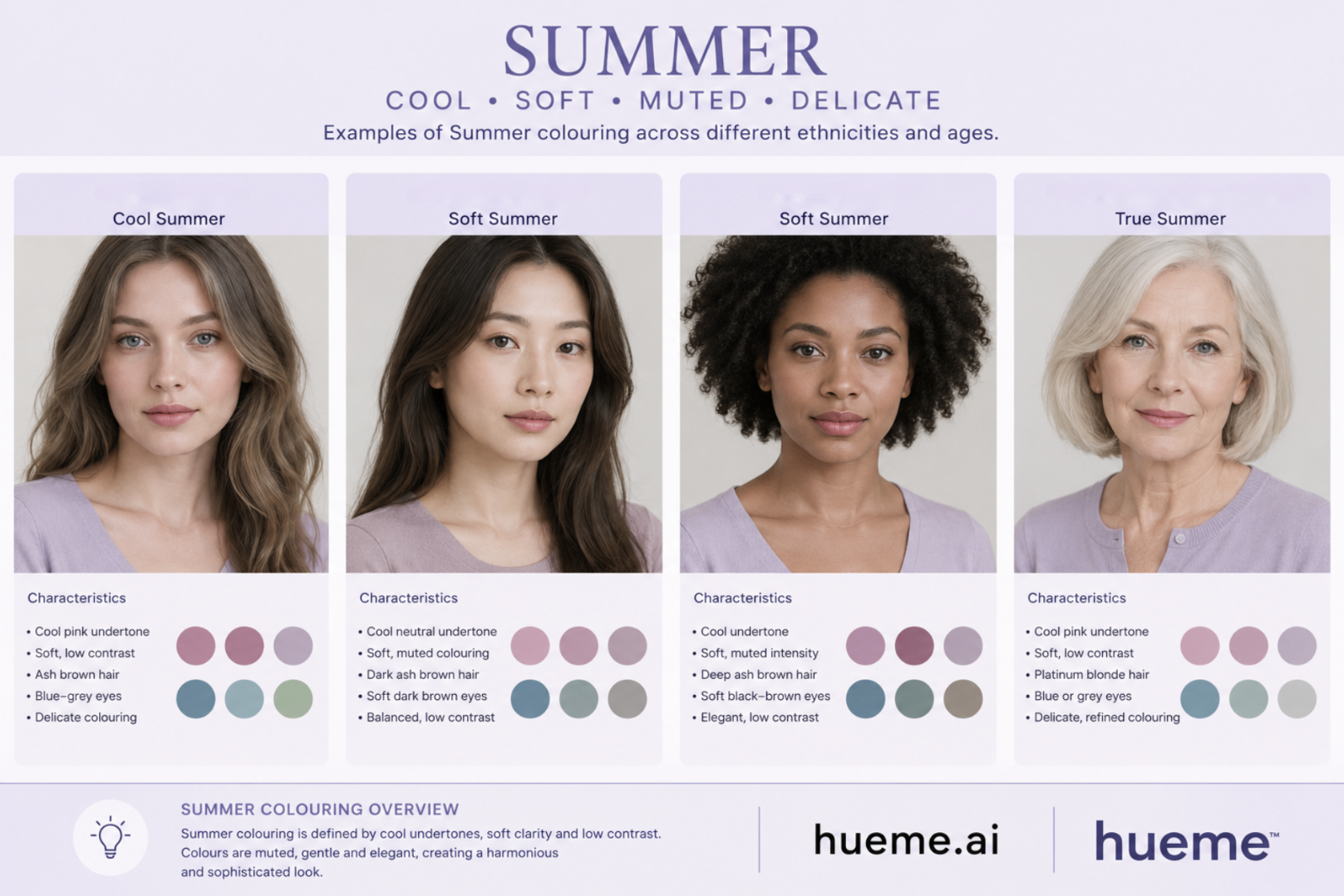
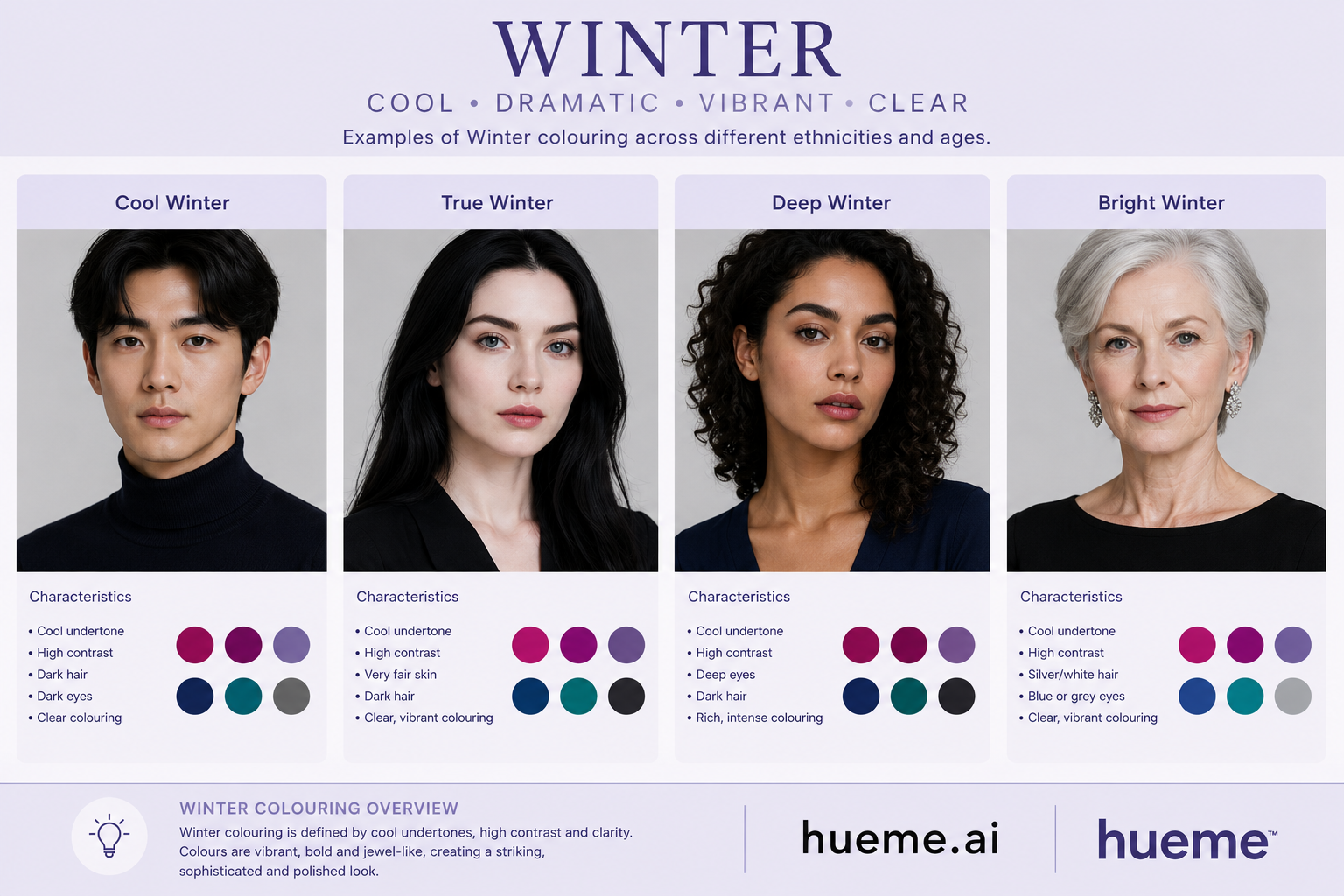
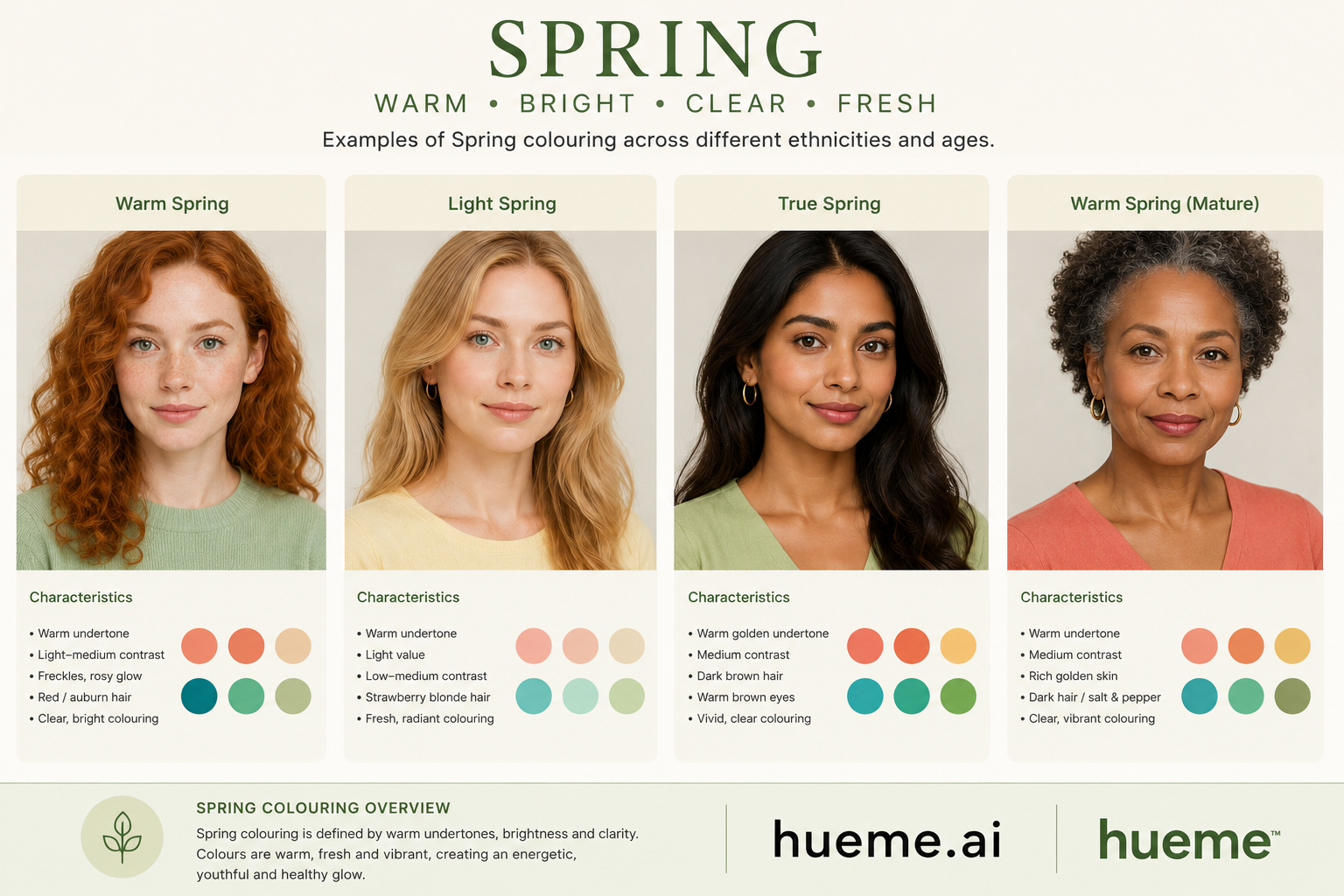
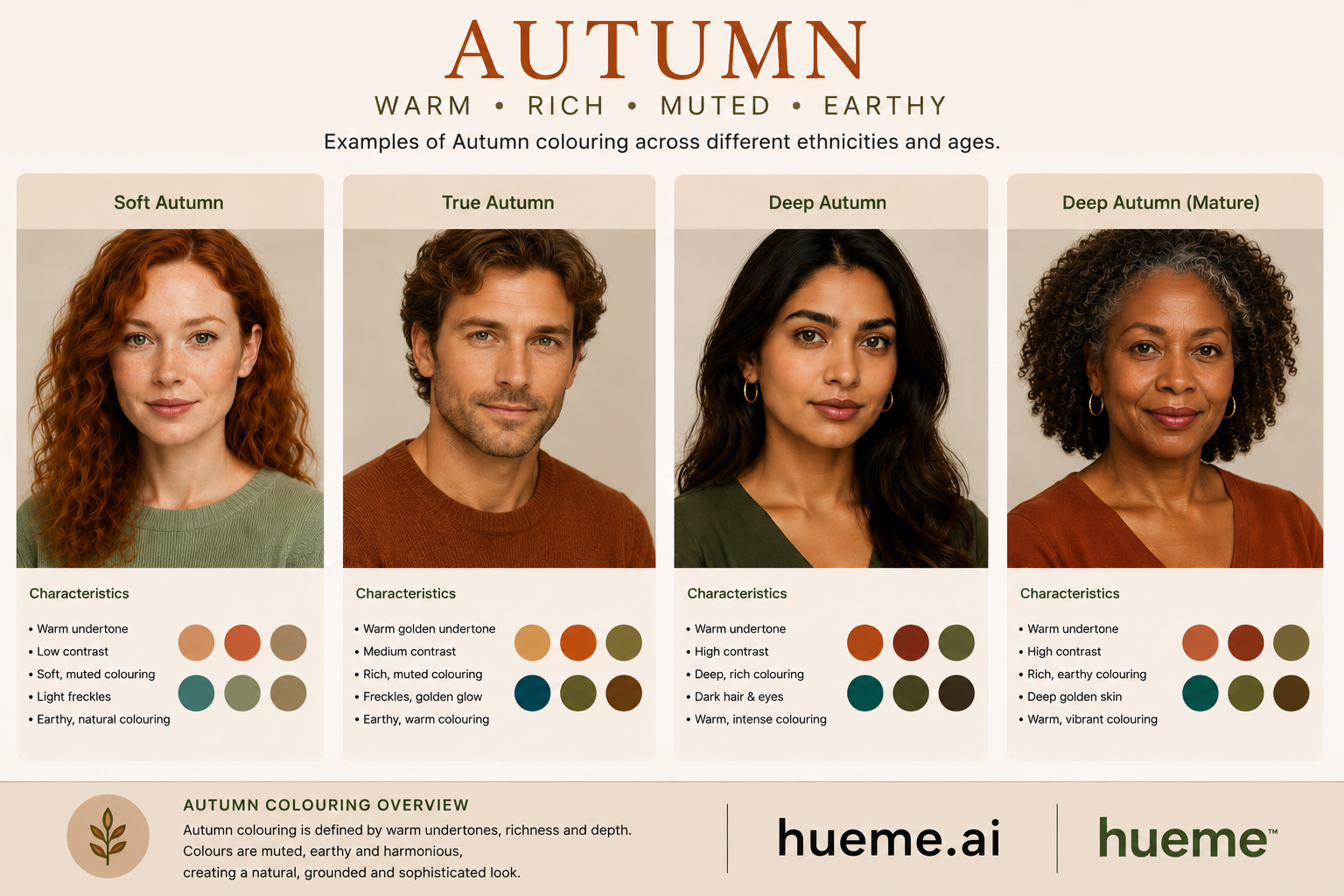
These reference charts show what each season can look like across different ethnicities and ages. Notice how within a single season the people may look outwardly very different, yet share the same underlying temperature, contrast and clarity. We group them by skintone temperature — cool first, then warm.
Cool skin
Summer & Winter
Blue, pink or rosy undertones. Skin sings next to silver, jewel tones and clear, cool colour.
Warm skin
Spring & Autumn
Yellow, golden or peachy undertones. Skin glows next to gold, earth tones and warm, sun-touched colour.
Discover yours
Which season are you?
Once you know your season, every colour decision gets easier — what to buy, what to bin, what to put on for the days that matter.
Try the interactive wheel →